A comprehensive system connecting internal tools and third-party services
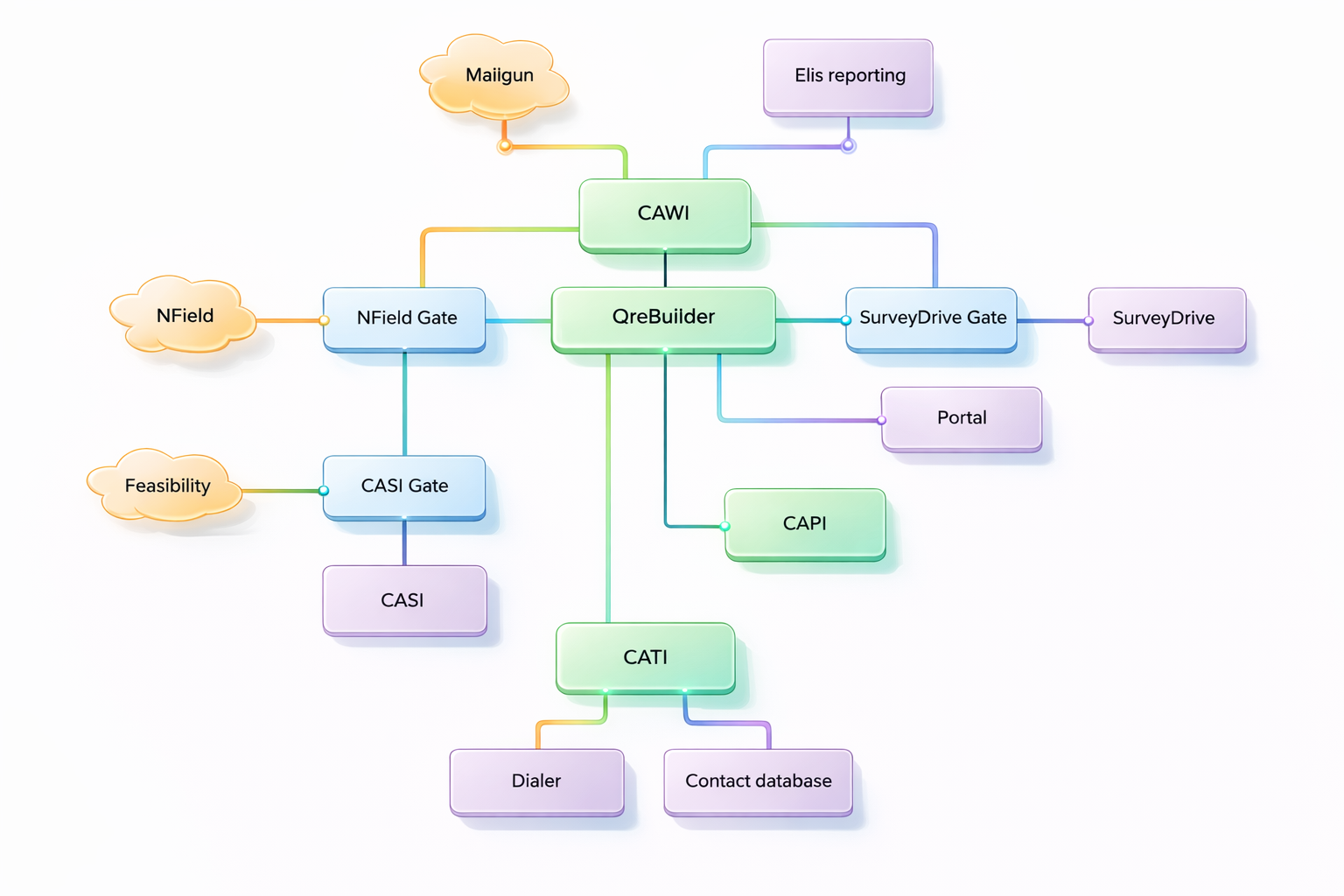
Ipsos is a long-standing leader in market research and public opinion polling. As a technology partner with deep knowledge of market research, we have been helping Ipsos shape its internal tools and connect them with third-party services for 10 years. This project built on the success of QreBuilder, which brought a clear process to questionnaire design. The next step was to integrate it into a wider set of services that support teams in the later stages of market research. Today, this jointly designed ecosystem connects more than 20 services and is used by over 300 users in 4 countries.
The existing systems were technologically outdated and didn’t support integration with other systems. Data was passed between them by hand – slowly and with a high error rate.
As the number of services grew, it became harder and harder to tell which stage a process was at, what had already happened and what had been forgotten. Data had to be pulled from several systems by hand and pieced together.
When problems occurred, it was practically impossible to identify the exact cause afterwards. There were no audit records and the origin of the data couldn’t be traced.
New needs and new tools kept coming, but without a common approach, changes were hard to introduce. Ipsos needed a way to connect new parts safely without losing the overview.
The solution is built around QreBuilder, where questionnaires are created and the main steps of the process are managed. The other services build on it, so teams work with the same data in the same way.
We connected previously isolated applications into one system in which services exchange data fully automatically. Outdated apps that couldn’t be connected were modernised or replaced entirely. Work now flows smoothly across departments.
Every important step in the system leaves a clear digital trail. It is easy to see what state the system was in at any point in the past. The audit trail also covers older parts of the solution that were never designed for it.
The ecosystem is designed to evolve step by step. Services were replaced while everything kept running, with no downtime at all. New services can be connected without major changes to the rest of the system and without losing the overview.
We design integrations using Event Modeling, which creates a shared visual diagram that both the business and developers understand. Changes are introduced quickly and effectively, without unnecessary misunderstandings.
A single source of truth saves a lot of coordination time. Everyone works with the same data in real time, so collaboration runs without noise. Preparing research projects now takes days instead of weeks.
Replacing manual steps eliminated human error. The result is consistent, always up-to-date information across the whole system.
The digital trail gives the client a detailed overview of every process. This lets us pinpoint quickly where a problem occurred, without a lengthy search for the cause.
A modular architecture and shared interfaces make it possible to connect more services and expand the ecosystem step by step. The system can grow with the company’s needs.

Commity isn’t just an external partner for us – it is an organic part of our team. After 10 years of working together, they understand our internal processes in depth, which allows them to propose concepts and directions that would otherwise stay hidden from us. It is a relationship built on complementing each other: we bring the vision of the market, and they help us shape it structurally and technologically into something that works.