Thousands of research projects in one digital environment
Ipsos is a long-standing leader in market research and public opinion polling. As part of our ongoing technology partnership, the Ipsos team approached us with another strategic challenge: to build QreBuilder. The goal was a robust internal system that would serve as the digital backbone of the whole company – a place where all research projects come together and that enables effective management of data and processes in one environment.

From design and technical preparation to data collection, everything has to match perfectly. Every small mistake in the brief carries over like a domino effect and threatens the validity of the research results.
Work spread across different tools and shared folders led to an endless chain of versions. Keeping ‘one version of the truth’ was very difficult in a team.
Project management relied on manual checks and constant communication. There was no single place that would instantly show the real status of projects and reveal where work was getting stuck.
Any later change had to be copied by hand into the downstream systems. This manual bridge between the brief and the technical side left room for critical errors in data consistency.
Materials were created in scattered formats with no common structure. This made any attempt at systematic automation or advanced machine processing impossible.
We developed QreBuilder as the company’s digital core. All projects are in one place, available to the whole team in real time, with no need to hunt for anything.
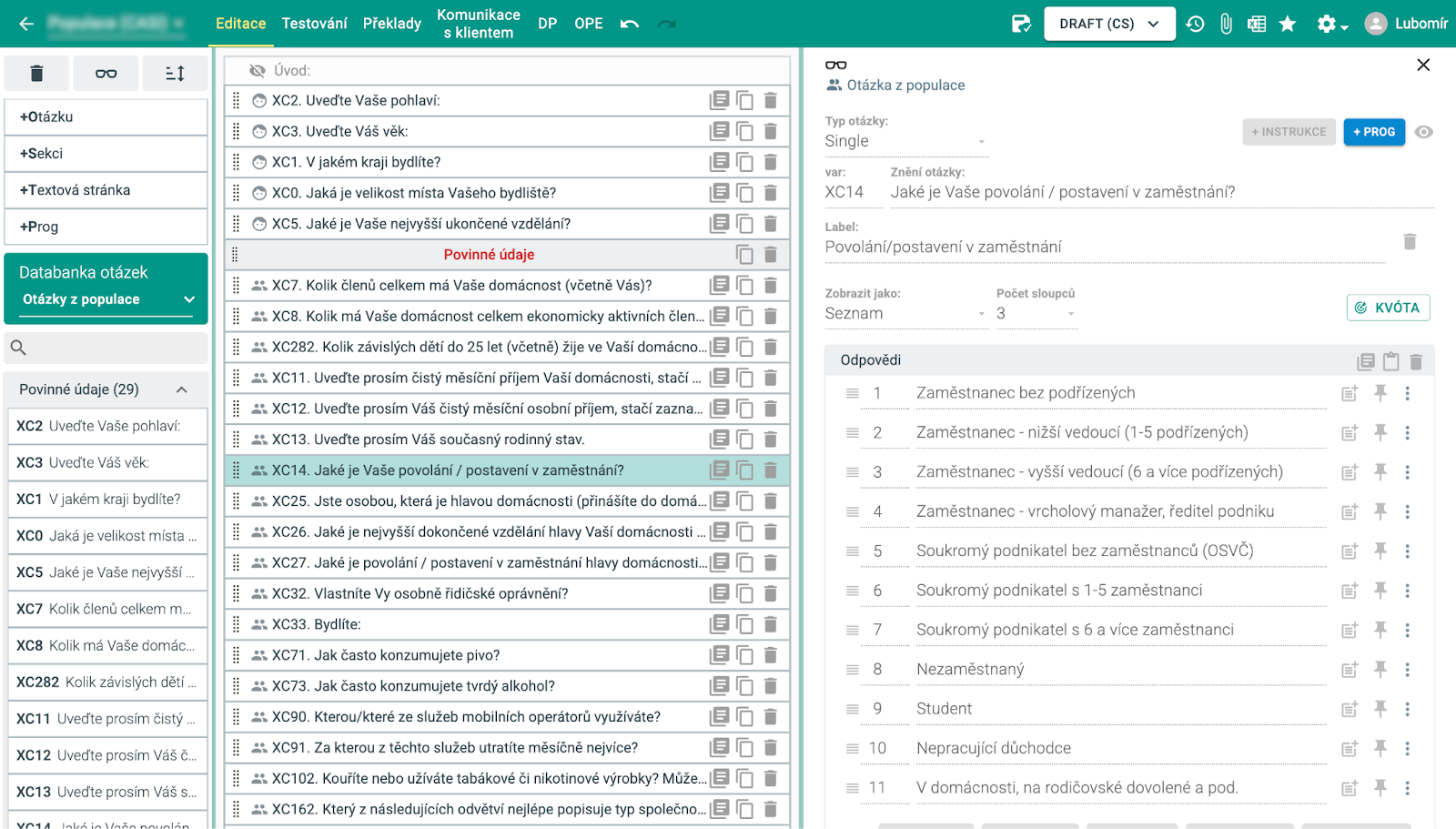
We turned questionnaires from plain documents into a structured data model. This enables instant versioning, reuse of proven modules across projects and a stable foundation for further automation.
A shared workspace replaced the unproductive sending of files back and forth. All fine-tuning happens directly in the tool, where every change is instantly visible, traceable and auditable.
The system automatically generates the technical basis of a questionnaire straight from the data model. QreBuilder detects differences between the brief and the script, which eliminates manual programming errors and keeps the data fully consistent.

Thanks to its machine-readable architecture, QreBuilder works as an open ecosystem. The platform is built from the ground up to connect external services and AI tools that push research automation even further.
QreBuilder removed the unproductive steps of handing over materials by hand and constantly consolidating different documents. Specialists are free of the admin burden and can focus fully on expert work instead of paperwork.
Technical preparation is 60% faster. On standard projects, the time saved reaches 80%; on complex briefs it is 30–50%. Automatic script generation and reuse of finished parts mean changes are applied instantly, with minimal risk of anything being missed.
The tool guides the process and keeps it fully transparent at every step. Change history and the option to return to earlier versions made consistency checks simpler and removed the errors that used to arise when information was passed between departments.
Files named ‘final_final_v2’ are a thing of the past. All questionnaire fine-tuning happens in a shared environment where a single online link leads to the current version. The team now has ‘one version of the truth’ and a full real-time overview of how each project is progressing.
QreBuilder has become a strategic tool for the Central European region. Today it unifies processes and technology standards in 4 countries (the Czech Republic, Slovakia, Austria and Hungary) and is a reliable foundation for thousands of research projects a year.

Our work included many routine tasks that we had long been trying to automate. We only succeeded with Commity, who gave us an extensive internal system for managing and creating questionnaires that can also generate them into ‘machine code’ for data collection. The system caught the attention of our partners abroad and is now successfully used in a number of other European countries.
